Lurvexiqeur
Lattice Mode
Lattice Mode
Couldn't load pickup availability
- 📄 Digital file available after purchase
- 🗂️ Long-term availability
- 🔒 Secure checkout
- 🗓️ Content updated in 2026
Self-paced learning overview
Problem Statement
As cloud architectures become larger, learners often encounter environments where services, computing resources, storage, networking, and operational components are spread across several layers. Even when individual relationships are understood, the complete system can become difficult to read when responsibilities overlap or connections cross between many areas.
Without a layered view, it may be harder to identify where a workload begins, which components process it, where information is stored, and which parts of the environment support monitoring and operational review.
Solution
Lattice Mode introduces layered and distributed architecture thinking.
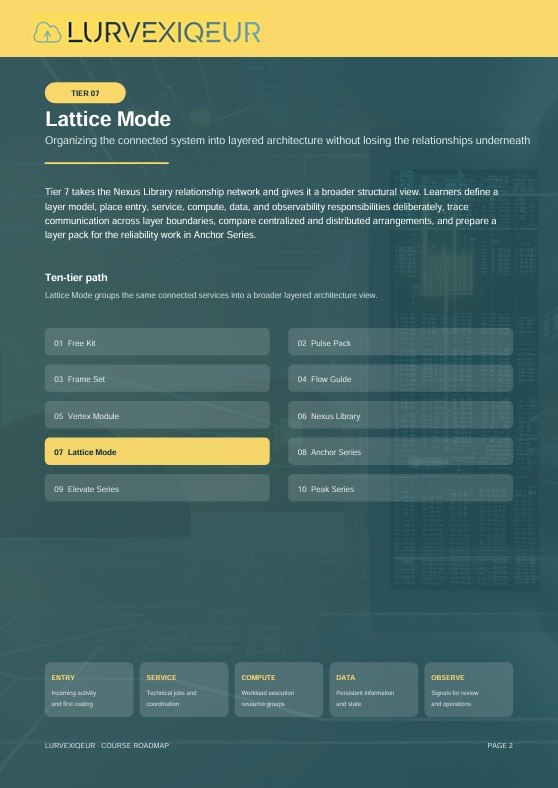
The course builds on the service relationships studied in Nexus Library and organizes larger cloud environments into logical sections. Learners examine how entry points, services, computing resources, data resources, and operational signals can be separated while remaining connected through clear communication paths.
What’s Inside
Lattice Mode includes structured modules covering layered architecture, distributed components, service separation, data relationships, cross-layer communication, system boundaries, and observability foundations.
Learners work with diagrams that divide environments into:
- Entry Layer
- Service Layer
- Compute Layer
- Data Layer
- Observability Layer
Activities include tracing workloads across several layers, identifying dependencies, and comparing different ways to organize distributed resources.
Who Is This For?
Lattice Mode is intended for:
- Learners continuing through the Lurvexiqeur course sequence
- Students exploring layered cloud architectures
- Learners studying distributed resource structures
- People practicing multi-layer architecture reading
- Anyone interested in understanding how system responsibilities can be separated
What You’ll Learn
By working through Lattice Mode, learners can:
- Identify major layers within larger cloud environments
- Separate service, compute, data, and operational responsibilities
- Follow workloads across multiple architecture layers
- Understand introductory distributed system structures
- Recognize cross-layer dependencies
- Map communication between separated components
- Identify system and service boundaries
- Read multi-layer architecture diagrams
- Compare centralized and distributed arrangements
- Understand the role of operational signals
- Organize complex environments into clearer sections
-
Trace information between service and data layers
Refund Terms
Refund requests may be submitted within 30 days of purchase in accordance with the store's Refund Policy. Eligibility and applicable conditions are described in the published refund terms.
Certification
The course includes a certificate of completion, giving learners a clear way to document that they have completed the Lattice Mode materials and studied its layered and distributed cloud architecture topics.
Share
Do I need previous cloud engineering experience?
Do I need previous cloud engineering experience?
Course requirements depend on the tier, but the collection begins with introductory material. Free Kit is designed for learners who are new to the subject, while later tiers gradually introduce broader concepts and more detailed technical study.
What type of learning materials are included?
What type of learning materials are included?
Depending on the tier, learners may find written lessons, structured modules, conceptual explanations, practical exercises, reference materials, diagrams, review sections, and guided activities connected to cloud engineering topics.
How are the Lurvexiqeur courses structured?
How are the Lurvexiqeur courses structured?
Each course follows an organized learning path built around cloud engineering foundations. Topics are divided into clear modules so learners can move from introductory concepts toward broader technical subjects at a steady pace.