Lurvexiqeur
Anchor Series
Anchor Series
Couldn't load pickup availability
- 📄 Digital file available after purchase
- 🗂️ Long-term availability
- 🔒 Secure checkout
- 🗓️ Content updated in 2026
Self-paced learning overview
Problem Statement
As cloud environments become more interconnected, learners need to understand what happens when an important component becomes unavailable or when one part of the system depends too heavily on a single resource. Architecture diagrams may look complete while still containing points where one interruption can affect several connected services.
Without a structured way to review these relationships, it can be difficult to identify where alternative paths, replicated resources, or recovery planning should be considered.
Solution
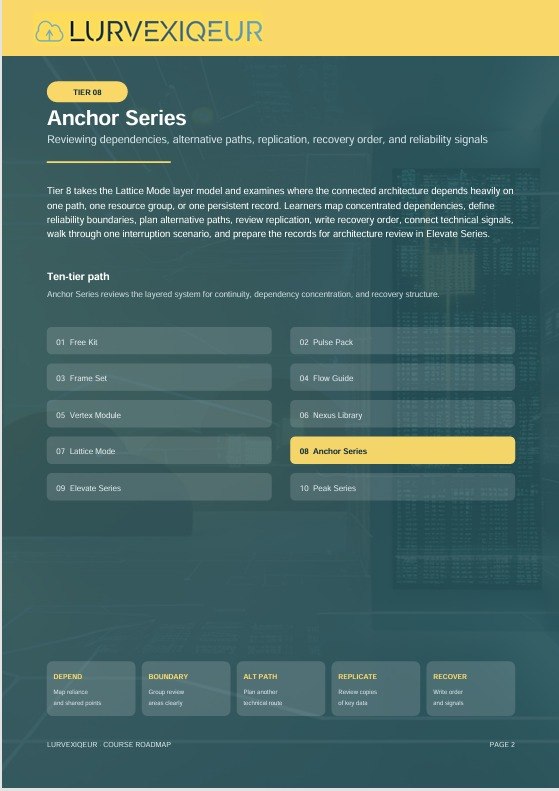
Anchor Series introduces foundational reliability, redundancy, and recovery concepts within cloud engineering.
The course builds on the layered and distributed structures explored in Lattice Mode. Learners examine how system dependencies can be reviewed, how alternative resource paths can be represented, and how replicated information can support continuity planning..
What’s Inside
Anchor Series includes structured modules covering redundancy concepts, dependency review, alternative resource paths, replicated information, interruption points, recovery sequences, and continuity planning.
Learners work with architecture diagrams that compare single-path structures with environments containing additional resources and alternative communication routes.
The materials also introduce methods for documenting recovery relationships and identifying components that several services depend on.
Who Is This For?
Anchor Series is intended for:
- Learners continuing through the Lurvexiqeur course sequence
- Students exploring reliability concepts
- Learners studying recovery and continuity planning
- People interested in reviewing architecture dependencies
- Anyone developing a broader understanding of resilient system structure
What You’ll Learn
By working through Anchor Series, learners can:
- Identify important dependency points within cloud environments
- Recognize single-path architecture structures
- Understand introductory redundancy concepts
- Compare primary and alternative resource paths
- Explore the role of replicated information
- Map recovery sequences in architecture diagrams
- Understand how several services may depend on one resource
- Review systems for concentrated dependencies
- Document alternative communication paths
- Trace workload movement during a recovery scenario
- Compare different continuity structures
- Connect reliability concepts with layered architecture
- Understand the relationship between redundancy and system design
Refund Terms
Refund requests may be submitted within 30 days of purchase in accordance with the store's Refund Policy. Eligibility and applicable conditions are described in the published refund terms.
Certification
The course includes a certificate of completion, giving learners a clear way to document that they have completed the Anchor Series materials and studied its reliability, redundancy, and recovery foundation topics.
Share
Do I need previous cloud engineering experience?
Do I need previous cloud engineering experience?
Course requirements depend on the tier, but the collection begins with introductory material. Free Kit is designed for learners who are new to the subject, while later tiers gradually introduce broader concepts and more detailed technical study.
What type of learning materials are included?
What type of learning materials are included?
Depending on the tier, learners may find written lessons, structured modules, conceptual explanations, practical exercises, reference materials, diagrams, review sections, and guided activities connected to cloud engineering topics.
How are the Lurvexiqeur courses structured?
How are the Lurvexiqeur courses structured?
Each course follows an organized learning path built around cloud engineering foundations. Topics are divided into clear modules so learners can move from introductory concepts toward broader technical subjects at a steady pace.